Home › Services
Parking lot paving in Columbia SC for churches, offices, shops and apartments
A parking lot is not a big driveway. It carries loaded trash trucks, box trucks backing to a loading door, and hundreds of cars turning their wheels in the same few spots every day. Around Columbia and the rest of the Midlands it also has to shed a summer thunderstorm in minutes and survive years of hard sun. This page walks a church committee, office manager, retail landlord or apartment owner through how commercial lots are designed, how the work gets phased so the doors stay open, when an overlay makes sense, how striping and accessible spaces are laid out, and how to plan maintenance so the next big bill arrives later. Send the address and a few photos when you are ready for a contractor to look.
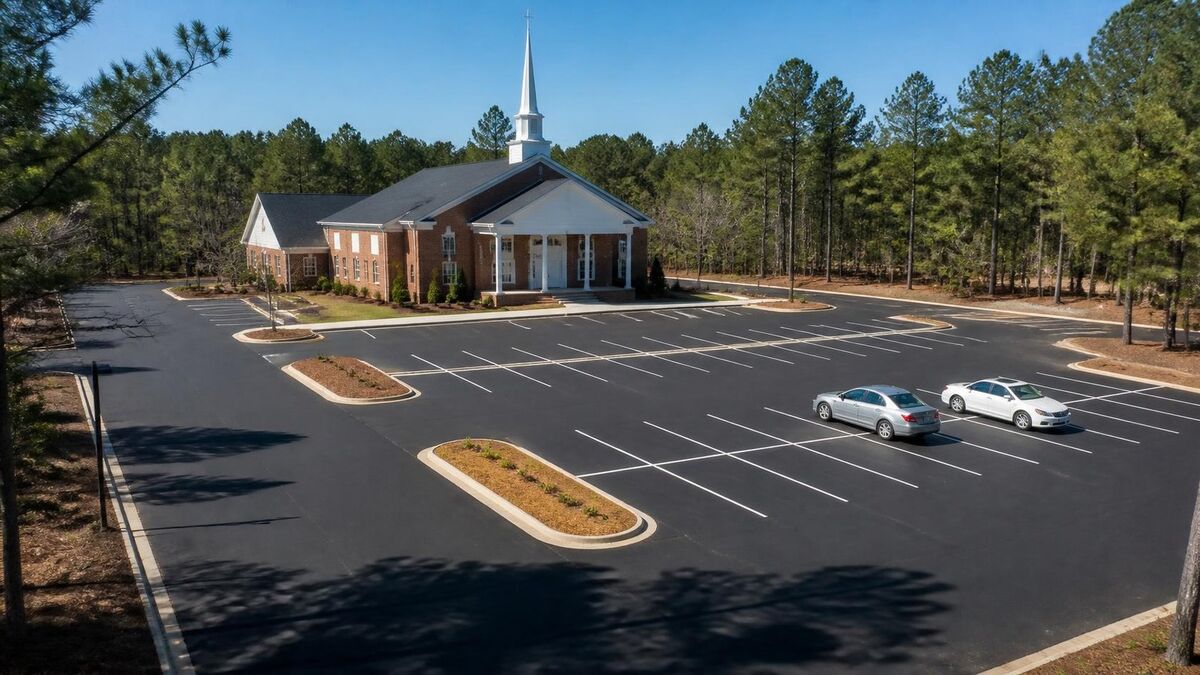
Different properties wear a lot in different ways
The first thing a good estimator asks is not how big the lot is but who uses it and when. A church lot sits almost empty most of the week, then fills in a single wave on Sunday morning and empties in another wave an hour or two later. An office lot fills at eight and drains at five, with steady light traffic and a dumpster enclosure that sees a heavy truck once or twice a week.
Retail is harsher. Customers circle, stop, reverse and turn constantly, and delivery vehicles use the same aisles shoppers do. Apartment communities combine everything: daily commuter traffic, moving trucks, a garbage truck on a schedule, overnight parking that leaves oil drips in the same stalls for years, and residents who expect the lot to be usable every single day.
Designing for trash trucks, delivery traffic and the heaviest wheel on the property
Pavement damage is driven far more by heavy axles than by passenger cars. A single loaded refuse truck can put more strain on a section of asphalt than a long stream of sedans, and it does it in the same path every week. That is why a well-designed lot is not one uniform thickness. The contractor maps where the heavy vehicles actually travel, from the entrance to the dumpster enclosure and from the street to any loading area, and builds those routes stronger than the car-only stalls.
In practice that can mean a deeper aggregate base along the truck route, an extra lift of asphalt in the drive aisles, or a concrete pad where the front-load truck sets its wheels and lifts the container. The exact section is specified by the contractor for the soils and traffic at your address, and a proposal that lists one thickness for the entire property deserves a follow-up question.
Drainage, inlets and Midlands thunderstorms
Water is what destroys parking lots, and a commercial lot collects a lot of it. A Midlands summer storm can drop heavy rain in a short burst onto a wide, nearly flat surface, and every bit of that surface has to send its water somewhere. If a low spot holds water, traffic pumps it down through cracks into the base, the base softens, and the area begins to rut and break up.
Good lot design sets gentle cross slopes and grade breaks so water travels in sheets toward curb lines, valley gutters or drop inlets, then into the storm system or a detention area.
Phasing the work so the business stays open
Very few owners can close their entire lot for a week. A store needs customers, an apartment complex needs residents to reach their doors, and a church needs somewhere for the congregation to park on its busy days. The answer is phasing: splitting the job into sections that are milled, paved and reopened one at a time while traffic is routed around the work with cones, barricades and temporary signs.
A practical phasing plan starts with the entrances, because nothing else works if people cannot get in. Busy retail lots are often done at night or early morning, offices on weekends, and church lots on weekdays. Fresh asphalt generally needs time to cool and stiffen before traffic and especially before striping, so the plan has to leave room for that between sections.
- Walk the lot with the contractor and mark which areas must stay open on which days.
- Agree on the order of sections and where temporary access and fire lane routes will run.
- Notify tenants, members or residents with a simple map and the dates for each zone.
- Pave, let each section cool, then reopen it before closing the next one.
- Stripe once the surface is ready, often as a final short visit across the whole lot.
Overlay, milling or rebuilding a commercial lot
Most aging lots in the Midlands do not need to be torn out. If the base is still sound and the surface is simply worn, oxidized and cracked, a new layer of asphalt over the old one can add many years of life. The catch is height. Every inch of new asphalt raises the surface against curbs, sidewalks, doorways, inlets and the street, and a lot cannot keep growing upward forever without water spilling over curbs or entrances getting a step.
Milling solves that. A milling machine grinds off a set depth of old asphalt, usually along curb lines, at entrances and around inlets, sometimes across the entire lot, so the new surface ends up at the right elevation. Where the base has failed, with deep ruts, wide alligator cracking or soft spots that flex under a truck, the contractor will dig those areas out and rebuild them before any overlay goes on. How those distress types are diagnosed is covered on the asphalt repair page, and full new construction from subgrade up lives on the asphalt paving page.
Line striping and lot layout that keeps traffic moving
Striping is the part of the lot people actually read. Clear lines decide how many cars fit, which way traffic flows, where pedestrians cross and where fire trucks can reach the building. Angled stalls with one-way aisles can move traffic more smoothly in a narrow lot, while ninety-degree stalls with two-way aisles often fit more cars where width allows.
Traffic paint for lots is commonly a water-based product, with longer-lasting options such as thermoplastic or more durable coatings used for crosswalks, arrows and stop bars. Fire lanes, curb marking and no-parking zones are set by the local fire authority for the address, so the striping plan should reflect what they require rather than what looks tidy.
Accessible parking spaces and the federal standard behind them
Accessible spaces are not a design choice. A federal accessibility standard governs how many accessible spaces a lot needs based on its total count, how they and their access aisles are laid out, how van-accessible spaces are handled, how the route from the space to the entrance must work, and what signage goes with them.
A striping contractor lays these spaces out to that standard every time a lot is restriped or rebuilt. Repaving is often when an older lot gets brought up to date, because the old layout may have been painted to an earlier understanding of the rules, or the spaces may sit on a slope that no longer works. The owner should ask to see the layout before paint goes down and confirm that the accessible route to the door is smooth and continuous.
A maintenance plan an owner can actually budget for
Commercial asphalt rewards owners who treat it like a roof: inspect it, maintain it on a cycle and replace it before failure spreads.
The basic rhythm is simple. Cracks get cleaned and sealed before water reaches the base. Small failed areas get cut out and patched before they grow. The surface gets a protective coat on a cycle that matches traffic and sun exposure, which is explained in depth on the sealcoating page. Lines are refreshed when they fade, which in a busy lot under South Carolina sun can come around sooner than owners expect. Eventually, a mill and overlay resets the clock.
- Walk the lot each spring and after major storms; photograph cracks, ponding and broken edges.
- Seal cracks while they are still narrow, ideally on a regular cycle.
- Patch failed spots promptly so traffic does not tear them wider.
- Seal and restripe on a schedule set with the contractor for your traffic.
- Plan the larger overlay years ahead so it can be funded and phased calmly.
What drives the cost of a parking lot project
Every lot is priced after a contractor sees it, because the factors that move the number are specific to the property. Size matters, but it is far from the only thing.
- Condition of the base and how much area needs digging out and rebuilding first.
- Milling depth and extent, and how much old material has to be hauled away.
- Asphalt thickness and the heavier sections needed on truck routes.
- Drainage corrections, inlet adjustments and curb or gutter repairs.
- Phasing, night or weekend work, and traffic control needed to keep the property open.
- Striping complexity, accessible-space updates, signage and wheel stops.
- Access for equipment, distance from the asphalt plant and the season the work is done.
What a parking lot proposal should spell out
When proposals from different contractors are side by side, the lowest number is often the one that leaves the most out. A useful parking lot proposal names the areas to be milled and to what depth, the areas to be dug out and rebuilt, the asphalt thickness for car areas and truck routes, the drainage work, the phasing plan and the striping layout, including accessible spaces. It should say what happens to the millings, who handles traffic control and how the lot is cleaned up afterward.
Ask how the contractor handles a soft area discovered once milling starts, because hidden base failure is common in older lots and the proposal should explain how that gets priced. Property owners across Richland and Lexington counties, from Forest Acres to the older commercial strips described on the Cayce and West Columbia page, can see the full list of communities on the areas page. When you are ready, send the address, the rough size of the lot and a few photos and a contractor working the region will take a look.
Parking Lot Paving: questions people ask
How long does it take to repave a parking lot?
It depends on the size, how much base repair turns up and how the work is phased. A small office or church lot with a straightforward overlay can sometimes be milled and paved in a short visit, while a large retail or apartment property worked in sections can stretch across several stages. The contractor sets the schedule after seeing the lot, and weather in a Midlands summer can shift any day of it.
Can a parking lot be paved while the business stays open?
Usually, yes. Contractors split the lot into zones, keep at least one entrance and a route to the door open, and pave one section at a time. Cones, barricades and temporary signs steer traffic around the work. The key is agreeing on the order of sections before work starts and giving tenants, members or residents a simple map of what closes when, so nobody arrives to find their usual spot blocked.
How soon can cars park on new asphalt in a parking lot?
Fresh asphalt needs to cool before it can carry traffic without marking. In mild weather that can happen within the same day, but on a hot South Carolina afternoon the mat stays soft longer, and turning tires or a parked car with its wheels cocked can leave scuffs. Striping is often held back a short while so the paint bonds well. The contractor will tell you when each section is ready to reopen.
Is it better to overlay or replace an old parking lot?
If the base underneath is still solid and the damage is mostly surface wear, cracking and fading, an overlay after milling the edges is often the economical choice. If large areas rut, flex under trucks or show widespread alligator cracking, the base has likely failed, and paving over it only hides the problem for a short time. A contractor can probe and core the lot to judge which applies.
How often should a commercial parking lot be restriped?
There is no single answer, because fading depends on the paint used, traffic volume and how much direct sun the lot takes. Busy retail lots and drive aisles wear lines out much faster than quiet church or office rows. Many owners pair a fresh coat of paint with each sealing visit, then touch up crosswalks, arrows and fire lanes in between if they wear early.
Why does water pond in my parking lot after it rains?
Ponding usually means the surface has settled in that spot, the original grades were too flat, or an inlet or curb outlet is blocked or sits too high. Over time traffic pushes water through cracks into the base, the base weakens, and the low spot deepens. Fixes range from clearing a clogged inlet to cutting out the area and regrading it, to adjusting grades across a section during an overlay.
Do I need a permit to repave a parking lot in Columbia?
It depends on the scope and the address. Resurfacing an existing lot in the same footprint is often treated differently from expanding a lot, adding new curb cuts onto a public road or changing how stormwater leaves the site. Those changes can involve the city or county planning, zoning and stormwater offices, and work tied to a state road may involve the state transportation department. The local office for the address has the final word.
Talk through your site
Start with the address, what you want done, and a few photographs of the area, including anywhere water sits after a heavy rain.
Related work
Asphalt Paving
New asphalt laid over a properly built base, for homes, churches, shops and small commercial lots.
Asphalt Driveways
Residential driveways built for Midlands sand, red clay, summer heat and the occasional heavy truck.
Asphalt Repair
Potholes, alligator cracking, edge breaks and soft spots, and when patching stops being worth it.
Sealcoating
Sealcoat and crack sealing that slows sun and water damage, and when sealing is wasted money.
Across the metro
Lexington
A fast-growing town west of the river, with newer subdivisions, long driveways and lake-area lots.
Irmo
Established neighborhoods toward Lake Murray, wooded lots, slopes and aging driveways.
Cayce and West Columbia
Older river-side neighborhoods and small commercial lots where repair and overlay work dominate.
Blythewood
Northeast growth corridor with larger lots, rural roads and long gravel-to-asphalt conversions.