Home › Services
Asphalt paving in Columbia SC, built from the subgrade up
Asphalt paving in Columbia SC is mostly about what nobody sees once the job is finished. The black surface you drive on is the last thin layer of a system that starts with the native soil, runs through a compacted stone base and ends with hot mix rolled tight before it cools. Get the hidden layers right and a Midlands pavement can shrug off August heat, summer downpours and the odd January freeze for a long time. Get them wrong and the best-looking surface course will rut, crack and pothole early. This page walks through how new asphalt is actually built, how to judge an overlay against full reconstruction, and what a proposal should tell you before you sign. When you are ready, send the address and a few photos.
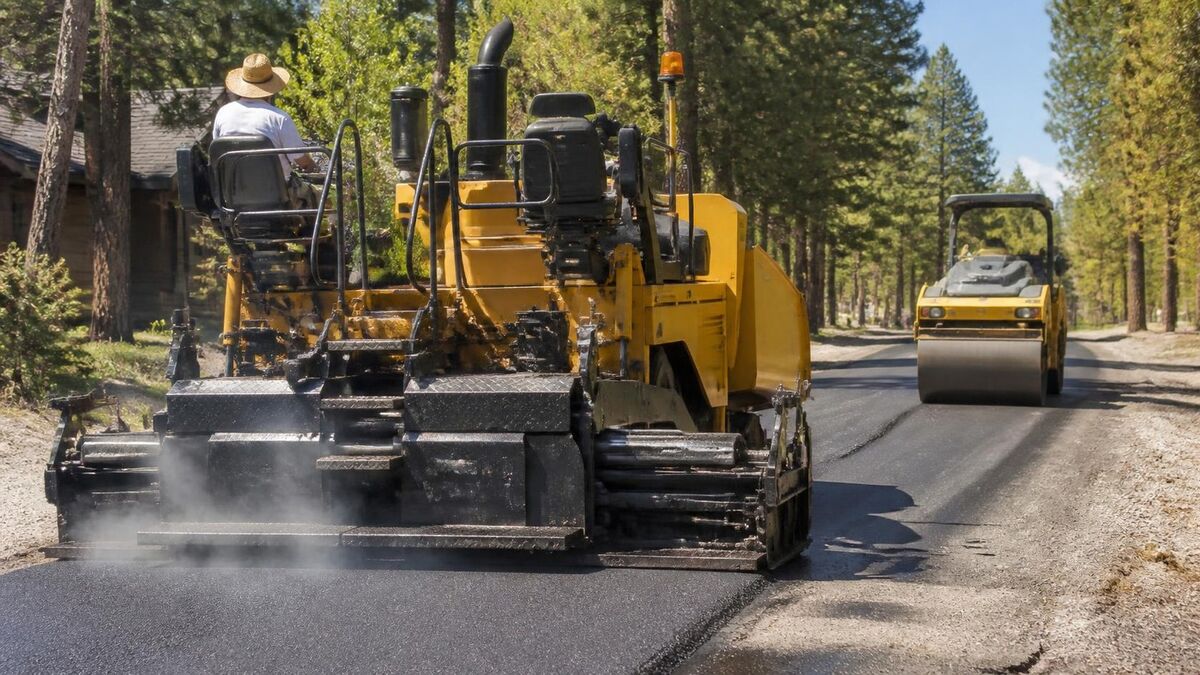
What new asphalt pavement really is
Hot mix asphalt is crushed stone, sand and a small share of liquid asphalt binder, heated at a plant and hauled to the site while it is still workable. By weight the rock does nearly all the structural work. The binder is the glue that holds those stones in a tight, interlocked mat, and it stays slightly flexible for years, which is why asphalt can ride over small movements in the ground that would crack a rigid slab.
That flexibility is also the catch. Asphalt does not bridge weak spots the way concrete partly can; it follows the shape of whatever sits under it. A soft pocket in the subgrade or a thin patch of base telegraphs straight up through the surface. So a paving job is really a ground-preparation job with a paving step at the end, and the quality of the preparation decides most of the outcome.
Excavation and the native subgrade
The first day usually involves removing whatever is in the way: old broken asphalt, grass and roots, topsoil and any organic material. The crew digs down to firm native soil or to the depth the contractor has planned for the new section, then shapes that soil to the grades the finished surface will follow.
Around Columbia the soil under a job can change within a few miles. Much of the area sits on the sandy ground along the fall line, where water drains quickly but loose sand can shift and resist compaction until it is confined. Other properties sit on red clay that holds water, swells when wet and shrinks and cracks in a dry spell. A contractor reads that soil before deciding how deep to dig, whether to add a stabilizing fabric, and how much stone the base needs.
Building and compacting the aggregate base
Over the prepared subgrade goes a layer of crushed aggregate, commonly a graded stone mix with fines that lock together when compacted. Residential work is commonly built with several inches of compacted stone, and heavier traffic calls for more, but the right depth is something the contractor specifies after looking at the soil and the loads.
Base stone goes down in lifts rather than one thick dump, because a vibratory roller can only densify so much material at a time. Each lift is spread, moistened if it is too dry, and rolled until it stops moving. The grades are checked again as the base comes up, since the stone layer is where the final slope and crown get locked in.
Proof rolling: the test that finds weak ground
Before any hot mix arrives, a careful crew will proof roll the base. That means driving a heavy loaded truck or roller slowly across the whole area and watching for any spot that pumps, deflects or ruts under the wheels. Ground that looks fine can hide wet clay, a buried stump or a utility trench that was never compacted.
When proof rolling turns up a soft area, the honest fix is to dig it out and replace it with stone, sometimes over fabric, and roll it again. A good proposal says up front how that undercut work will be handled and priced. Skipping the test does not make the weak spot go away; it just moves the failure into year two.
Binder course, surface course and the compaction window
Many sections go down in two layers, a binder course and a surface course. The lower one uses coarser stone for strength; the top uses a finer mix that seals tighter and looks smoother. A thin tack coat between them makes the layers bond. Driveways and lighter jobs are sometimes paved in a single lift, while lots that carry trucks usually get both. A church or shop lot that sees trash trucks needs a heavier section than a home, and the contractor sets the thickness for the site; driveway-specific choices are on the asphalt driveways page and multi-user lots on the parking lot paving page.
Hot mix has to be rolled while it is still hot enough to move. Once it cools past a certain point the stones stop sliding into place and the mat stays porous no matter how many passes the roller makes. Midlands summers stretch that working window, which helps, while a cold, windy day in winter shrinks it fast. Crews watch mix temperature at delivery and roll in a set pattern so the edges and seams get the same density as the middle.
Drainage, crown and slope decide how long it lasts
Water is the main enemy of asphalt. Standing water softens the base, works into fine cracks and, in the rare hard freeze, expands and pries the surface apart. Every new pavement needs a planned path for water to leave, whether that is a crown down the middle, a cross slope to one side, or a gentle grade toward an inlet or swale. Flat spots that hold puddles a day after a storm are a design problem, not bad luck.
Heavy summer thunderstorms around Columbia can drop a lot of rain in a short time, so the contractor should think about where that water goes once it leaves the pavement too. On sloped lots, the plan may include a ribbon curb, a shallow swale or a turnout to carry water away cleanly.
Edges: where most new pavement starts to fail
An asphalt edge with nothing beside it to hold it in place is the weakest part of the job. Tires that drop off the side load the unsupported edge and break it down over time, and water soaks in along the side where the base is exposed. A well-built pavement either extends the base past the asphalt edge, slopes the edge at an angle so it is less likely to crumble, or ties into a curb or concrete border.
Ask how the edges will be finished and backfilled. If the edges on an existing surface are already crumbling, that is repair territory, covered on the asphalt repair page.
Overlay or full-depth reconstruction?
When there is already old asphalt in place, the first decision is whether to pave over it or tear it out. An overlay lays a new surface course over the existing pavement after the cracks are sealed, the low spots are leveled, and any failed sections are cut out. It costs less and goes faster because there is far less excavation. But it only makes sense when the base underneath is still sound; an overlay on top of a failing base simply inherits the failure, often within a couple of seasons.
Full-depth reconstruction removes the old pavement and some or all of the base, fixes the subgrade and builds everything new. It is the right call when the surface shows widespread alligator cracking, deep ruts, heaving or areas that sink under load. Milling is a middle path: a machine grinds off the top of the old surface so the new layer can go on without raising the grade at doors, garage slabs and curbs.
- Overlay tends to fit pavement with surface cracking and wear but no soft spots or sinking.
- Milling and overlay tends to fit surfaces where the grade cannot rise because of thresholds, curbs or drainage.
- Full-depth work tends to fit pavement with base failure, standing water problems or no real base to begin with.
What a complete paving proposal should spell out
Two quotes for the same property can look miles apart simply because they describe different jobs. Before comparing prices, line the proposals up against each other and check that each one answers the same questions in writing.
- The area to be paved, measured, with a simple sketch or marked photo.
- What gets removed and hauled away, and what happens to the old material.
- How the subgrade will be checked, including proof rolling, and how undercuts of soft ground are handled and priced.
- The base material and its compacted depth, as specified by the contractor for this site.
- The asphalt mix type, the number of layers and the compacted thickness of each.
- The drainage plan: crown or slope, where water exits, and any swale, curb or pipe work included.
- How edges and tie-ins to the street, garage slab and walks will be finished.
- Cleanup, backfill and seeding along the edges, and who handles permits for any street work.
- Workmanship coverage terms in plain language, along with payment schedule and what happens if weather delays the job.
Cost drivers, weather and timing in the Midlands
Paving prices move with a handful of real factors: the size of the area, how much demolition and excavation is needed, the condition of the soil, the base and asphalt depths, access for trucks and equipment, the distance from the plant, and the price of liquid asphalt itself, which tracks oil markets. Small jobs carry a high share of fixed cost for mobilizing a paving machine, rollers and a crew, so a tiny area rarely costs as little as people expect. The contractor prices the work after seeing the property.
Most paving in the Midlands happens from spring through fall, when the ground is dry and air and surface temperatures keep the mix workable. Before any digging, SC811 should be contacted so buried lines are marked. To get a contractor looking at your property, start on the contact page, and browse the Midlands communities this site serves.
Asphalt Paving: questions people ask
How long does new asphalt need before I can drive on it?
Fresh asphalt hardens as it cools, so foot traffic is usually fine within a day and cars often a couple of days after that, though the contractor will give you the timing for your job. Full curing takes much longer because the binder keeps stiffening for months. During the first hot summer, avoid turning the steering wheel while parked, keep kickstands and trailer jacks off the surface, and park in different spots so tires do not press the same dents into soft pavement.
Can asphalt be paved directly over dirt or gravel?
Paving straight onto bare soil almost always fails early, because asphalt needs a firm, evenly compacted base to carry weight. Existing gravel can sometimes become part of the new base, but only after it has been checked, regraded, topped up with fresh aggregate where it is thin, and compacted. Mud holes, organic soil or ruts in an old gravel surface need to be dug out first. The contractor decides how much of the existing material can stay after inspecting it in person.
Why do some paving quotes in Columbia differ so much?
Large gaps between quotes usually come from different scopes rather than different profit margins. One bid may include removing old pavement, proof rolling, undercutting soft spots and two layers of asphalt, while another assumes a thin single lift over whatever is already there. Ask each contractor to put base depth, asphalt thickness, mix type, drainage work and edge finishing in writing. Once the scopes match, the price comparison means something, and the cheapest number often turns out to be a smaller job.
Is it better to pave in summer or fall in South Carolina?
Both work well here. Summer gives the longest working window because hot air and pavement keep the mix pliable during rolling, but afternoon thunderstorms can interrupt a day. Early fall often brings drier, steadier weather and still-warm ground, which many crews like. Late fall and winter jobs are possible on mild days, though cold surfaces cool the mix faster and shorten the time available to compact it. Contractors tend to book up in peak months, so planning ahead helps.
Do I need a permit to repave my property?
It depends on the address and the scope. Repaving inside the same footprint often needs nothing, while widening, adding a new curb cut, tying into a public street or changing how stormwater leaves the lot can bring the city, the county or the state road agency into it. Neighborhood associations may have their own approval step too. The contractor or the local permitting office can tell you what applies, and a good proposal says who is responsible for filing.
How thick should a new asphalt surface be?
There is no single correct number. Homes are commonly built with a few inches of compacted asphalt over a deeper stone base, and lots that see trucks need more of both. The right section depends on the soil under the site, how wet it stays, and the heaviest vehicles that will use it. Be wary of anyone who quotes a thickness without looking at the ground, and make sure the compacted depth, not the loose depth, appears in the written proposal.
Does new asphalt need to be sealed right away?
No. Fresh asphalt still has oils working their way out of the binder, and sealing too early can trap them and leave a soft, scuffable surface. Most contractors suggest waiting through at least several months of warm weather before the first coat, and some prefer a full year. The timing and the case for sealing at all are covered on the sealcoating page, along with when it is worth the money.
Talk through your site
Start with the address, what you want done, and a few photographs of the area, including anywhere water sits after a heavy rain.
Related work
Asphalt Driveways
Residential driveways built for Midlands sand, red clay, summer heat and the occasional heavy truck.
Asphalt Repair
Potholes, alligator cracking, edge breaks and soft spots, and when patching stops being worth it.
Sealcoating
Sealcoat and crack sealing that slows sun and water damage, and when sealing is wasted money.
Parking Lot Paving
Lots for churches, offices, shops and apartments: paving, overlays, drainage and striping.
Across the metro
Lexington
A fast-growing town west of the river, with newer subdivisions, long driveways and lake-area lots.
Irmo
Established neighborhoods toward Lake Murray, wooded lots, slopes and aging driveways.
Cayce and West Columbia
Older river-side neighborhoods and small commercial lots where repair and overlay work dominate.
Blythewood
Northeast growth corridor with larger lots, rural roads and long gravel-to-asphalt conversions.